

Estimated reading time: 8 minutes
Think about how you solve problems nowadays. Your water heater starts leaking, so you pull out your phone and look up how to fix it. Someone in the family has a strange rash, so you type the symptoms into a search bar. You want to can this year's tomato harvest, so you pull up a recipe. We take all of that for granted because the answer is always a few clicks away.
Now imagine the grid is down. Permanently. How would you solve those problems with no Internet?
When a real disaster strikes, you won't be able to order a book from Amazon or run to the nearest Barnes & Noble. You won't be able to hop online and look up whatever you need to know. All of that accumulated human knowledge that feels so accessible right now simply disappears the moment the internet does. That's exactly when you'll wish you had certain reference books sitting on your shelf.
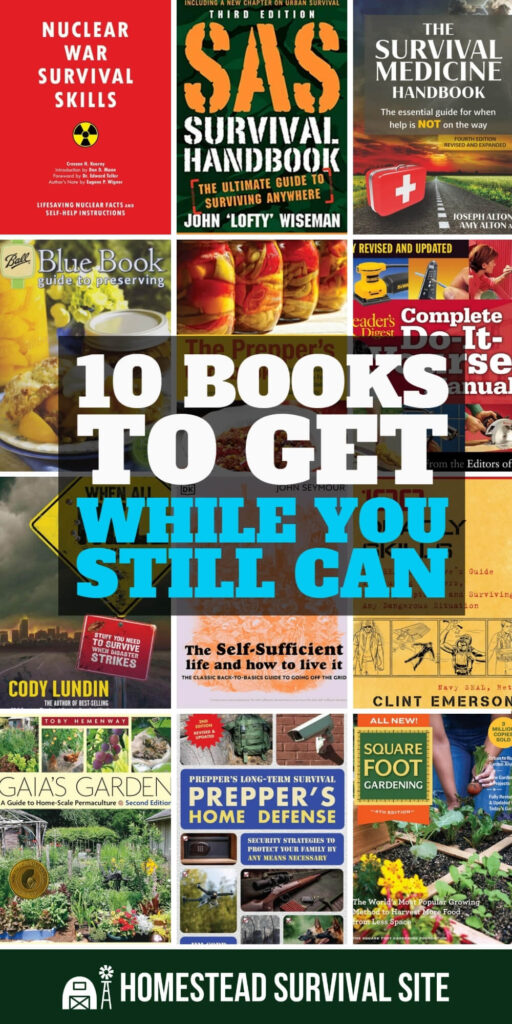
Below are 10 categories of books worth owning before you need them, with a standout title in each and a note on why it's worth getting. This list comes from the YouTube channel, City Prepping, which put together an excellent rundown of the books worth having when the grid goes dark.
You can watch his video and view the list below.
Want to save this post for later? Click Here to Pin It On Pinterest!
1. Medical: The Survival Medicine Handbook
If there's one category to get right, it's this one. In a true disaster, when an ambulance might be hours away or not coming at all, solid medical information could be the most valuable thing on your shelf.
The Survival Medicine Handbook by Dr. Joseph Alton and Amy Alton (the couple behind the Doom and Bloom channel) is written specifically for situations where professional help isn't available. It walks you through handling injuries and illnesses when you have to be the end of the line, which is a very different mindset from a normal first-aid guide.
For longer grid-down scenarios, pair it with Where There Is No Dentist. It was written for developing regions without dental care, and anyone who has suffered through a bad toothache knows how quickly that becomes a serious problem with no easy fix.
2. Food Preservation: The Ball Blue Book Guide to Preserving
Storing food is one thing. Preserving it so it lasts is another skill entirely, and it's one of the first every prepper should learn. The go-to reference here is the Ball Blue Book Guide to Preserving, the long-running canning classic that has sold millions of copies and shows up on nearly every list of recommended food preservation guides. It covers canning, pickling, and preserving in clear, tested steps.
Good supplements in this category include The Prepper's Cookbook by Tess Pennington, which centers on cooking from the kinds of staples you'd have stored away, and Meals in a Jar by Julie Languille, which helps you assemble ready-to-store meals. The key theme across all of them is rotation: you want to actually cook and eat your stored food regularly so nothing goes to waste and you stay familiar with it.
3. Gardening: All New Square Foot Gardening
When your food supply eventually runs low, the ability to grow more becomes priceless. All New Square Foot Gardening by Mel Bartholomew is where most new gardeners are told to start, and for good reason. It's practical, beginner-friendly, and makes efficient use of small spaces, which matters if your growing area is a suburban backyard.
Round it out with a few specialized titles: Gaia's Garden by Toby Hemenway for a permaculture approach, Carrots Love Tomatoes by Louise Riotte for companion planting (which plants help each other thrive when grown side by side), and The Forager's Harvest by Samuel Thayer for identifying and collecting wild food when your garden isn't enough.
4. Homesteading: The Self-Sufficient Life and How to Live It
Homesteading is gardening's more ambitious cousin. It's about turning your property, however big or small, into something that can sustain you. The Self-Sufficient Life and How to Live It by John Seymour is the title that consistently rises to the top. It's a bit more advanced and tends to assume you have some land, but it covers an enormous range of self-reliance skills in depth.
For a more approachable, suburban-friendly starting point, The Backyard Homestead is excellent. If you're keeping animals, The Chicken Whisperer's Guide to Keeping Chickens goes deep on backyard flocks. And the Foxfire series is worth having for its documentation of old-time skills and traditional ways of doing things that were nearly lost.
5. Survival and Prepping: When All Hell Breaks Loose
This is the broad, all-purpose survival category, and two books stand out. When All Hell Breaks Loose by Cody Lundin comes up again and again as one of the most recommended practical survival books, and the SAS Survival Guide by John “Lofty” Wiseman is the compact classic packed with useful field skills. If you could only grab one, the SAS guide is a hard one to beat as a starting point.
Beyond those, this category is deep: How to Survive the End of the World as We Know It by James Wesley Rawles, The Prepper's Pocket Guide by Bernie Carr for beginners, Prepper's Long-Term Survival Guide by Jim Cobb, 52 Prepper Projects by David Nash for hands-on learning over a year, and The Survival Mom by Lisa Bedford for getting a household ready.
6. Home Repair: The Complete Do-It-Yourself Manual
We don't often think of a repair manual as survival gear, but consider the reality of a prolonged grid-down situation. Something breaks and there's no handyman to call and no video to watch. You have to fix it yourself. The Reader's Digest Complete Do-It-Yourself Manual is a thorough, updated reference covering repairs and projects throughout the house. It's the kind of book you don't appreciate until the moment you desperately need it.
7. Self-Defense: 100 Deadly Skills
If things go sideways, being able to protect yourself and your family becomes a real concern. 100 Deadly Skills by Clint Emerson, a former Navy SEAL, gets strong reviews and offers practical, memorable techniques worth filing away in the back of your mind.
Pair it with Prepper's Home Defense by Jim Cobb, which approaches the topic from a preparedness angle: how to harden and defend your home if the situation calls for it.
8. Nuclear and Disaster-Specific: Nuclear War Survival Skills
Some threats are severe enough to warrant their own dedicated reference. With nuclear tensions weighing on a lot of minds, having solid information on this specific scenario is reassuring rather than alarmist. Nuclear War Survival Skills by Cresson Kearny is a well-known guide to surviving nuclear fallout, and the official U.S. Armed Forces survival manuals cover the subject from a military standpoint. These are books you hope to never open, but you'd be glad to have if you did.
9. Finances: Financial Peace and Rich Dad Poor Dad
People rarely connect finances with preparedness, but the link is direct: prepping costs money. Gear, food storage, and supplies all add up, and getting your financial house in order is what makes the rest possible. Financial Peace by Dave Ramsey is a strong starting point for learning the basics of getting out of debt and living within your means.
From there, Rich Dad Poor Dad by Robert Kiyosaki reshapes how many readers think about money and assets, and The 10X Rule by Grant Cardone lights a fire under anyone looking to get more aggressive about their goals. (Kiyosaki's Cashflow Quadrant is another eye-opener in the same vein.) Read the ideas, take what's useful, and don't get too hung up on the personalities behind them.
10. The Future: Principles for Dealing with the Changing World Order
The last category is about zooming out and understanding where the world is heading, drawing on people who spend their careers studying exactly that. Principles for Dealing with the Changing World Order by Ray Dalio lays out the big historical cycles that shape economies and nations. (Dalio also has a 43-minute video by the same title that's well worth the time.)
For balance, read it alongside The End of the World Is Just the Beginning by Peter Zeihan, who sees the coming decades a little differently. And The Sovereign Individual, written back in 1997, is a dry but fascinating look ahead, much of which you can watch playing out in real time. The common thread among all three is simple: the world is changing, and it pays to get ready for it.
Where to Start
That's a lot of books, and you don't need to buy all of them at once. If you're just getting started and want a place to begin, three titles rise above the rest: the SAS Survival Guide, When All Hell Breaks Loose, and The Survival Medicine Handbook. Get those three on your shelf first, then fill in the categories that matter most to your situation.
The bigger point is this. All of the information in these books is easy to get right now, which is exactly why now is the time to get it. Knowledge stored on a shelf doesn't care whether the power is on. Build that library while you still can.
Like this post? Don't Forget to Pin It On Pinterest!
You May Also Like: